
Algorithms used for Microspectroscopy
Transmittance
Transmittance calculates a transmission spectrum from a sample and reference single-beam spectra.
From Two Single-Beam Spectra a transmission spectrum using the following formula:
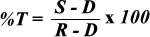
where R is the single beam spectrum of the reference material, S is the single beam spectrum of the sample and D is the dark counts of the system.
From Absorbance Data a transmission spectrum can be generated using the following formula:

where A is the absorbance value. This is a calculation from data that has already been collected.
Absorbance
Absorbance calculates an absorption spectrum from a sample and reference single-beam spectra or from a transmission spectrum.
From Two Single-Beam Spectra an absorption spectrum can be generated using the following formula:
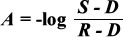
where R is the single beam spectrum of the reference material, S is the single beam spectrum of the sample and D is the dark counts of the system.
From Transmission Data an absorption spectrum can be generated using the following formula:

where %T is the percent transmittance value. This is a calculation from data that has already been collected.
Reflectance
Reflectance calculates a reflectance spectrum from a sample and reference single-beam spectra or from an log 1/R spectrum.
From Two Single-Beam Spectra a reflectance spectrum can be generated using the following formula:
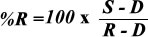
where R is the single beam spectrum of the reference material, S is the single beam spectrum of the sample and D is the dark counts of the system.
