Ultraviolet-visible-near infrared Spectrophotometry
Spectroscopy is the study of how electromagnetic energy interacts with matter. There are many types of spectroscopy and they are used to detect, identify and quantify data about material samples as gases, liquids and solids. As such, spectroscopy is used to determine both the chemical composition as well as measure the physical properties of matter.
Spectrometers are devices that are used to measure the spectra of samples. Typically, they measure the electromagnetic radiation intensity as a function of the wavelength of the radiation. There are many types of spectrometers designed to measure different types of spectra and to yield different types of information about their material samples. For example, a spectrophotometer measures ultraviolet, visible and near infrared light that is either reflected from or transmitted through a sample. A Raman spectrometer measures the light scattered from a sample via Raman scattering. A fluorescence spectrometer measures the spectra of light emitted from a sample that has absorbed light at a different wavelength. All these different instruments give us different types of information about samples.
What is the function of a spectrophotometer?
Why does your spectrophotometer have to measure different wavelengths?
How to choose the wavelength for the spectrophotometer?
How Does a Spectrophotometer Work?
The basic components of a spectrophotometer are the light source, a sample holder, a device to separate the light into its component wavelengths and a detector.
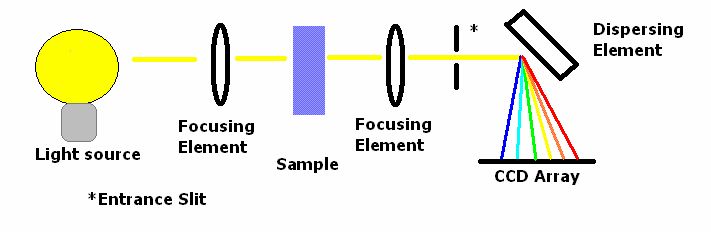
The system focuses electromagnetic energy from the light source onto the material sample. Depending upon the system configuration, light is either reflected off the sample or transmitted through it. After the light is collected from the sample, it is focused onto the entrance slit of a monochromator. The monochromator is used to separate the light by wavelength using a dispersing element, most commonly an optical grating. That light is then focused onto a charge coupled device (CCD), which is made up of thousands of individual detectors, so that the intensity of light at each wavelength may be measured. The CCD is then read-off to a computer and the result is a spectrum which displays the intensity of each wavelength of light, as shown below.
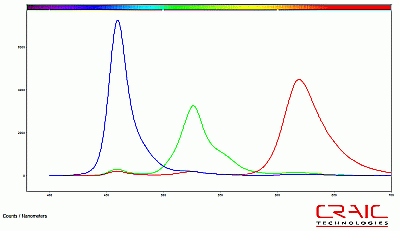
While spectrophotometers can measure electromagnetic radiation from the deep UV to the near infrared, the spectrum shown above is an example just from the visible range. This is the part of the spectrum which we perceive with our eyes as color. The spectrum shows the intensity of light versus the wavelength, though our eyes would see each of those peaks as a different color. Thus the blue peak corresponds to blue colored light, while the green and red peaks are green and red respectively.
How Does a Microspectrophotometer Work?
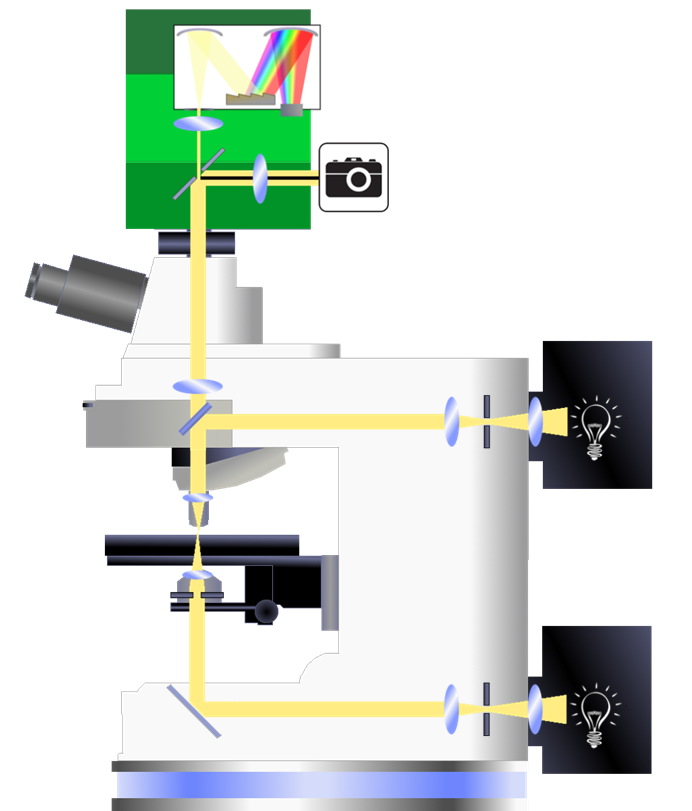
A microspectrophotometer, such as those made by CRAIC Technologies, integrates a spectrophotometer with a microscope so that the spectra of microscopic samples may be measured. Below is a diagram of the 508 PV™ Microscope Spectrophotometer integrated with a microscope so that the system can measure UV-visible-NIR spectra in both reflectance and transmission of microscopic samples. Additionally, the system is also thin film thickness measurements, colorimetry and color imaging of the samples.