Algorithms used for Microspectroscopy

Microscope spectrometers are used in many fields.

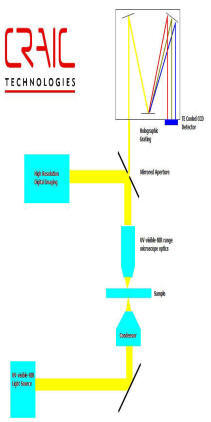
Light is transmitted through the sample, collected by the objective and focused onto the aperture and simulaneously an image and spectrum are collected.

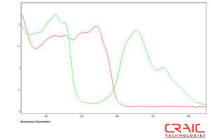
Transmission spectrum from a microspectrophotometer.

Transmittance
Transmittance calculates a transmission spectrum from a sample and reference single-beam spectra.

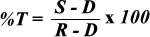
From Two Single-Beam Spectra Transmission can produce a transmission spectrum from two single-beam spectra using the following formula:

Percent transmission calculation

where R is the single beam spectrum of the reference material, S is the single beam spectrum of the sample and D is the dark counts of the system.

From Absorbance Data:
A transmission spectrum can be generated from an absorbance spectrum using the following formula:

Convert absorbance to percent transmission.

where A is the absorbance value. This is a calculation from data that has already been collected.

Absorbance
Absorbance calculates an absorbance spectrum from a sample and reference single-beam spectra or from a transmission spectrum.

From Two Single-Beam Spectra:
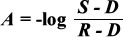
Absorbance can produce an absorbance spectrum from two single-beam spectra using the following formula:

Absorbance calculation

where R is the single beam spectrum of the reference material, S is the single beam spectrum of the sample and D is the dark counts of the system.

From Transmission Data:
Absorbance can also generate an absorbance spectrum from a transmission spectrum using the following formula:
Convert percent transmission to absorance.

where %T is the percent transmittance value. This is a calculation from data that has already been collected.

Reflectance
Reflectance calculates a reflectance spectrum from a sample and reference single-beam spectra or from an log 1/R spectrum.

From Two Single-Beam Spectra:
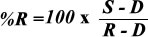
Reflectance can produce a reflectance spectrum from two single-beam spectra using the following formula:

Percent reflectance calculation.

where R is the single beam spectrum of the reference material, S is the single beam spectrum of the sample and D is the dark counts of the system.
Microscope Objectives
Microscope objectives can be quite complex devices using either lenses or mirrors to collect and focus light.  There are two basic designs for ultraviolet-visible-NIR capable objectives:

  • Ultrafluar: This type of objectives uses lenses made of quartz with air mounts to collect and focus light.  Also called quartz objectives.  The advantages are a good image quality.
  • Schwarzschild: These objectives use two parabolic mirrors to collect and focus light.  Also called mirror objectives or reflecting objectives.  The advantages are a very broad range from the deep UV to the near IR with no chromatic aberration and high energy throughput.

Objectives are defined by a number of factors, some of which include the magnification, resolving power, numerical aperture and working distance.

  • Magnification: the amount that the image is magnified by the objective. The range of useful magnification is arbitrarily defined as 500 to 1000 times the numerical aperture of the objective.  Magnifications above these values do not yield higher resolution of sample detail.
  • Resolving power: the smallest feature that can be distinguished.  The objective is just one component that defines the resolving power of the microscope "system".  There are a number of ways to approximate the resolving power of an objective with the simplest being R = w / 2(NA) where R is the theoretical maximum resolving power of the objective, w is the wavelength of the light and NA is the numerical aperture of the objective.  As can be seen, using a shorter wavelength of light or a higher NA objective means a better spatial resolution.
  • Numerical Aperture (NA): a measure of the ability of the objective to gather light.  It is defined as NA = n(sin q) where n is the refractive index of the imaging media and q is the half-angle of the maximum cone of light that can enter the objective.
  • Working Distance: the distance between the front lense of the objective and the sample surface when the specimen is in focus.