
Tuning Biochar Feedstocks: Optimizing Pyrolysis with Vitrinite Reflectance and Raman Microspectroscopy
Consistency is a persistent challenge in biochar production. Biochar feedstocks vary naturally in composition, and differences in pyrolysis conditions further influence carbon structure, usually in ways that conventional testing, such as elemental and proximate analysis, cannot fully capture. As demand grows for biochar in agriculture, environmental remediation, and carbon sequestration, detailed structural characterization has become increasingly important for managing biochar quality. Vitrinite reflectance and Raman microspectroscopy provide insight that can be utilized to evaluate thermal maturity, monitor carbon development, and optimize feedstock selection and production conditions.
Vitrinite Reflectance and Raman Microspectroscopy
Vitrinite Reflectance as a Thermal Index
Vitrinite reflectance has served for decades as a reliable indicator of thermal maturity in organic materials. It measures the percentage of incident light reflected from polished organic components under oil immersion microscopy. When biomass experiences progressively elevated temperatures during pyrolysis, its carbon structure undergoes aromatization, producing aromatic networks with a higher degree of structural order that reflect more light.
Because reflectivity rises in a predictable manner, vitrinite reflectance acts as a microscopic thermal indicator. Engineers can determine the maximum temperature individual particles experienced instead of relying solely on reactor setpoints. That distinction is important because temperature distribution inside industrial reactors is rarely uniform. Localized variations may leave portions of the feedstock insufficiently converted or expose others to excessive heating. Measuring reflectance across polished samples reveals differences quickly and offers direct evidence of thermal consistency throughout production.
Raman Microspectroscopy as a Structural Map
Complementing thermal analysis, Raman microspectroscopy examines carbon at the molecular level through laser-induced scattering. The resulting spectrum reflects the vibrational behavior of carbon bonds, delivering detailed information about structural organization during pyrolysis.
Two characteristic spectral features receive particular attention:
- The D-band represents structural defects and disordered carbon
- The G-band represents increasingly ordered graphitic carbon networks.
Monitoring changes in the D/G intensity ratio captures the transformation from heterogeneous biomass into thermally stable aromatic carbon. Raman microspectroscopy thus establishes direct confirmation of molecular ordering, allowing researchers to evaluate structural development that bulk analytical techniques cannot resolve.
Optimizing Pyrolysis and Tuning Biochar Feedstocks
Biomass feedstocks rarely exhibit complete uniformity. Softwood, hardwood, corn stover, rice husks, sugarcane bagasse, and forestry residues all contain different proportions of lignin, cellulose, hemicellulose, minerals, and moisture. These compositional differences influence heat transfer, volatile release, and carbonization behavior during pyrolysis. Mixing multiple feedstocks within a single production campaign introduces additional variability that cannot be detected solely through average compositional measurements.
Effective process optimization considers how individual particles respond to identical operating conditions. Vitrinite reflectance provides rapid feedback by identifying differences in thermal maturity across polished biochar samples. Areas exhibiting lower reflectance indicate incomplete carbonization, revealing locations where temperature or residence time proved insufficient for full structural development.
Insufficient processing generates practical consequences. Residual volatile organic compounds remain trapped within the carbon matrix, leaving biochar that decomposes more readily after incorporation into agricultural soils. Consequently, carbon intended for long-term sequestration may lose stability far sooner than anticipated. Detecting under-pyrolyzed regions helps operators to adjust residence time, reactor loading, or heating profiles before inconsistent production becomes routine.
Excessive thermal treatment introduces another challenge. Raising temperatures beyond the optimal operating window increases energy consumption and may damage the porous architecture responsible for water retention, nutrient exchange, microbial habitat formation, and contaminant adsorption. Biochar intended for vineyard soils, row crop production, stormwater filtration, or heavy metal adsorption relies on interconnected pore networks that support water retention, nutrient exchange, and microbial colonization. Preserving such structures remains just as important as maximizing carbon stability to ensure the biochar retains the physical properties it needs for its intended application.
Raman microspectroscopy provides a practical way to monitor these structural changes. Tracking the evolution of the D-band and G-band reveals when aromatic ordering has reached the desired level without progressing toward unnecessary structural modification. Once the appropriate molecular organization develops, extending thermal exposure offers limited benefit and increases operating costs.
Using vitrinite reflectance and Raman microspectroscopy together delivers a comprehensive understanding of pyrolysis performance. Vitrinite reflectance verifies uniform heat distribution across heterogeneous feedstocks and confirms thermal maturity throughout the reactor. Raman microspectroscopy validates that carbon bonds have reorganized into stable aromatic structures capable of supporting long-term carbon storage and certification requirements. Combined datasets connect feedstock characteristics, reactor conditions, and molecular structure, helping engineers to refine operating parameters with considerably higher precision than conventional bulk analysis.
Precision Tools for Advanced Carbon Materials
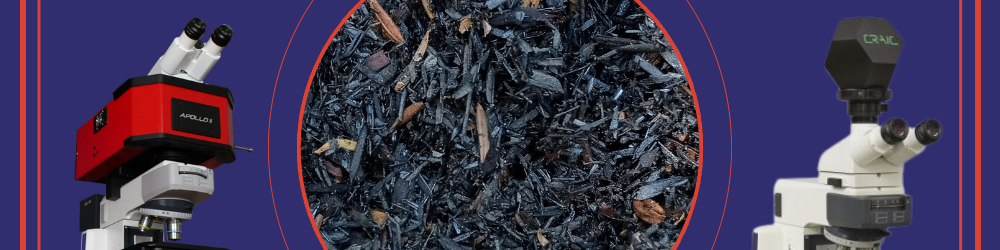
Moving biochar from a commodity soil amendment to a certified carbon material calls for detailed characterization during production. CRAIC Technologies supports this transition with specialized instrumentation engineered for detailed carbon characterization. The GeoImage™ system delivers high-resolution vitrinite reflectance analysis for evaluating thermal maturity across heterogeneous samples. Meanwhile, the Apollo M™ Raman Microspectrometer provides detailed molecular mapping using Raman microspectroscopy. Each of these technologies enable researchers and industrial producers to optimize feedstocks, refine pyrolysis conditions, and verify carbon quality. Reach out to our experts now to discover how our analytical instruments can reveal the structural changes that shape biochar quality and performance.
References
- Bird M, Brock F, Collinson M, et al. Chemical Characteristics of Macroscopic Pyrogenic Carbon Following Millennial-Scale Environmental Exposure. Frontiers in Environmental Science. 2020;7(203). doi:10.3389/fenvs.2019.00203.
- Bei K, Chou I-M, Fu Q, et al. Effects of Vitrinite in Low-Rank Coal on the Structure and Combustion Reactivity of Pyrolysis Chars. ACS Omega. 2020;5(28):17314-17323. doi:10.1021/acsomega.0c01542.
